- Congress
- Transcultural competence in everyday clinical practice
- Physical and mental health aspects in the context of migration
- Frequently occurring diseases by country of origin and transit country
- Migration and health over our lifespan (special features for pregnancy, children and older people)
- Mental health of medical staff
- Legal framework
- You know the physiological and psychological foundations of stress
- You can recognize, diagnose and treat body stress disorders
- You will learn skills for communicating these disorders
- You can better recognize your own stress and learn 2-3 helpful personal strategies for dealing with stress
- They know the effects of sleep, exercise, mindfulness and solitude on health and can use their therapeutic potential in everyday clinical practice
- They understand the term “social prescribing” and can implement interventions in this regard
- They can use PRISM (Pictorial Representation of Illness and Self Measure) to assess and treat their patients’ distress
- You know the basics of the biopsychosocial approach in gynecology / obstetrics
- You have an overview of the occurrence and treatment options for sexual and psychological disorders in women
- You know how to integrate questions about sexuality, violence and psychological stress into your biopsychosocial anamnesis
- You are familiar with trauma-sensitive patient care
- You are competent in communicating bad news in a peripartum and oncological context
- You feel up to ethically sensitive care situations
- You are skilled in patient-centered communication during challenging decision-making processes
- They have practiced strategies to take care of themselves in stressful care situations
- Practice-oriented – reference to everyday practice and clinical practice
- Personal – the reference point is your own professional and private experience
- Interactive – dialogic and discursive forms of learning
- Sustainable – offer of group supervision after 5, 7 and 9 months
EAPM Congress 2026
This year’s annual conference of the European Association for Psychosomatic Medicine (EAPM) took place in Florence in June. As part of SAPPM’s collective membership, all SAPPM members are automatically members of the European umbrella organization, the EAPM.At this year’s conference, the Swiss care model was presented under the title “The Swiss Model,” among other topics. Care in Switzerland is based on the interdisciplinary subspecialty SAPPM as well as the subspecialty of Consultation-Liaison Psychiatry. Compared to other European and global countries, Switzerland has one of the highest densities of care providers in psychosomatic medicine. Switzerland therefore serves as a model for countries that are in the process of establishing their own biopsychosocial care structures.
The EAPM
The EAPM’s mission is to promote the biopsychosocial approach in healthcare throughout Europe, whether in research, education, or clinical care.
The annual EAPM meetings are characterized by a combination of a welcoming atmosphere and academic exchange. They are held alternately in various European cities. In 2027, Paris will be the host city.
Climate Crisis and Mental Health
This Special Interest Group (SIG) aims to address the mental health challenges posed by global warming within the framework of the European Association for Psychosomatic Medicine (EAPM).“We want to use our expertise to address the various causes and biopsychosocial consequences of the climate crisis and to inspire change toward planetary health.”
This European expert group strives to better understand the mental barriers to climate action, as well as the psychological and psychosomatic aspects resulting from climate transformation. A strong focus is placed on strengthening research and training in this area, as well as on networking with other international associations.
As an SAPPM member, you are invited to join the Special Interest Group by signing up for the mailing list with the chair, Isolde Busch.
Please email isoldemartina.busch@univr.it
Delegates’ Assembly
On May 28, 2026, the 20th SAPPM Delegates’ Assembly took place. This joyful anniversary event was held at the Galerie Kornfeld in Bern. Many thanks to everyone involved!According to the bylaws, delegates are selected on a self-organizing basis from the various bodies of the SAPPM (e.g., regional, specialized, and working groups; continuing education institutes; continuing education centers, etc.).
Together with the Executive Board, the Delegates’ Assembly discusses the professional association’s current business and future developments and reviews their financing.
The Delegates’ Assembly is open to all members and takes place each spring.
The next Delegates’ Assembly will take place on May 20, 2027, in Basel, in conjunction with the SGAIM Spring Congress.
Books
On this page you will find information on new scientific publications, new editions and standard works of psychosomatic medicine.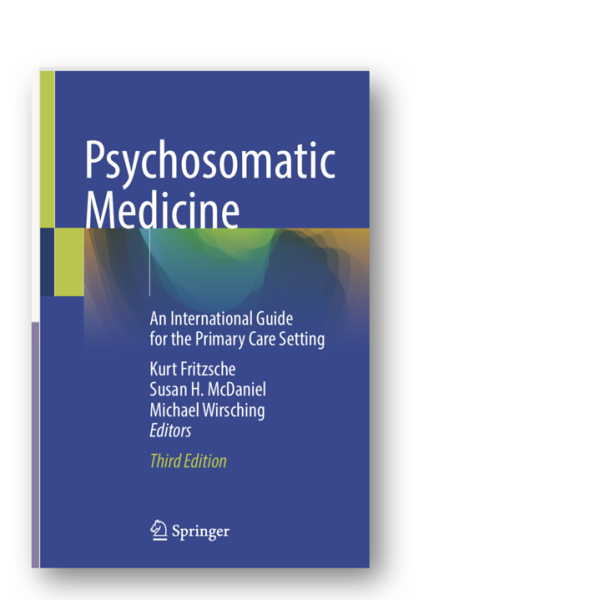
Psychosomatic Medicine –
An International Guide for the Primary Care Setting
Kurt Fritzsche, Susan H. McDaniel, Michael Wirsching (eds.) 3rd edition, Springer 2026
English, 593 pages, also available as eBook
The new edition of this standard work is characterized by an expansion of the country contributions: Around 20 country reports from 4 continents broaden the view of our subject to a global perspective. The reports from current crisis areas such as Lebanon, Syria, Palestine, Israel and Ukraine are particularly illustrative and impressive. The country reports from Asia are fascinating due to their different cultural-ethnological coloring of the “psychosomatic” topic. The Western country reports are characterized by Cartesian terminology and a comparatively high institutional anchoring of the medical field.

Uexküll – Psychosomatic medicine
Johannes Kruse et al (eds.), 9th edition, Elsevier 2025
Over 100 chapters, all brought up to date, 39 of which have been completely rewritten.
In the 9th edition, Uexküll once again presents all aspects of psychosomatic medicine in a comprehensive and well-founded manner. In line with Thure von Uexküll’s ideas, the work aims to promote the integration of psychosomatic thinking in all medical specialties and is therefore deliberately not limited to the field of psychosomatics and psychotherapy. The therapeutic attitude is decisive: the focus is on the patient and his or her individual reality, which must be taken into account in order to achieve an optimal therapeutic result. No therapeutic approach is regarded as the only valid one; different explanations and approaches are taken into account.

Migration and refugee medicine
A. Exadaktylos, O. Keidar, D. Srivastava, D.H. Paris (eds.), Hogrefe 2025
The reference book “Migration and Refugee Medicine” is a reference work in condensed form and reliably helps to build up and safely apply medical knowledge for the 20 most important countries of origin.
The following interprofessional topics are covered in the practical guide:

Psychosomatics – neurobiologically sound and evidence-based
Ulrich T. Egle, Christine Heim, Bernhard Strauss, Roland von Känel (eds.) 2nd edition, Kohlhammer 2024.
The specialist and textbook is now available in a second and revised edition.
With specialist contributions from more than 170 authors.In 100 chapters, this textbook and handbook provides an up-to-date review of the scientifically proven biopsychosocial foundations of psychosomatics, and then builds on this to present the diagnosis and treatment of the most important psychosomatic illnesses. This is supplemented by contributions on the history of psychosomatics, epidemiology, health economics, psychosocial prevention, social medicine and assessment.

DOULEURS ET ÉMOTIONS
Anne-Françoise Allaz, Vigot, 2021
Les douleurs chroniques, qui affectent 20% de la population, sont-elles une fatalité ?
En intégrant les dimensions émotionnelles à leur engagement dans des thérapies combinées, les personnes qui souffrent peuvent influencer positivement les systèmes de contrôle de la douleur.

General psychosomatic medicine
Peter Henningsen, Springer 2021
This book for doctors interested in psychosomatic medicine brings together the diverse empirical and conceptual developments that have occurred since the second half of the 20th century and reflects on their clinical significance. In particular, the scientific-theoretical starting point of psychosomatic medicine in relation to the subjective is addressed.
CAS Eating Disorders
Diagnosis and treatment of eating disordersCertificate of Advanced Studies (CAS) Faculty of Medicine, University of Zurich
Subject
The course provides comprehensive interdisciplinary skills in
the diagnosis and treatment of eating disorders (anorexia nervosa,
bulimia nervosa, binge eating disorder, atypical eating disorders). Eating disorders
are psychiatric illnesses that are characterized by high rates of comorbidity,
chronicity, mortality and recurrence. Treating
these disorders is often a challenge. The CAS
provides in-depth interprofessional expertise in this specialist area.Admission/target audience
A university degree in medicine, psychology or
nutritional sciences and practical experience are required for admission. In exceptional
me cases, persons with comparable qualifications and
specific practical experience may also be admitted “sur dossier”. The course is aimed at
specialists from the fields of psychiatry, child and
adolescent psychiatry, psychosomatics, psychotherapy, general internal
medicine and pediatrics as well as psychology, nutritional science and
nutritional counseling. Professional experience in the field of eating disorders and/or
completed further training in psychotherapy is an advantage for the application.Lecturers
The lecturers and supervisors are medical specialists or specialist psych
chologists who have additional disorder-specific training certificates
and proven expertise in the field of eating disorder treatment.Place and date
The course starts in October 2026 and takes place approximately once a month,
on Thursdays, usually from 9.00 to 17.00, in Zurich.
Total duration: 2 semestersDegree
Certificate of Advanced Studies UZH in Diagnosis and Treatment of
Eating Disorders (10 ECTS credits)SAPPM credits
63 credits (32 theory, 16 skills, 15 supervision)Costs
CHF 9,600. Included are comprehensive course documents and materials,
teaching and learning support by qualified lecturers, 5 half days of
supervision by experienced specialists in eating disorder treatment, a
final discussion and snacks during the courses.
Sponsorship
The sponsorship is the responsibility of the Faculty of Medicine of the University of Zurich. The
course is run by the Psychiatric University Clinic
Zurich, Child and Adolescent Psychiatry and Psychotherapy – Prof. Dr.
med. Susanne Walitza, KD Dr. med. Dagmar Pauli – and the University
tätsspital Zurich, Clinic for Consultative Psychiatry and Psychosomatics – Prof. Dr.
med. Roland von Känel, Prof. Dr. med. Gabriella Milos. The CAS is supported by the
Swiss Society for Eating Disorders.Head of the study program
Prof. Dr. med. Gabriella MilosRegistration
Applications will be accepted until September 01, 2026 at the latest.
Please request a registration form from CAS.ES@usz.ch.Organization and contact
University Hospital Zurich
Clinic for Consultative Psychiatry and Psychosomatics
Tel.: 044 255 97 17
E-Mail: CAS.ES@usz.chReady for TARDOC? We have the answers!
“Can I combine the psychosomatic position with the basic consultation?” “Do I have to submit an application?” “What changes in group sessions?”We regularly receive these and many other questions. That’s why we have completely revised our TARDOC page: with a comprehensive FAQ, direct contacts to your tariff delegates and all the important information on position JZ.00.0010, which will apply from January 1, 2026.
Get an overview now – so that switching tariffs becomes routine for you.
Stress medicine 2026
Stress medicine: GPs play a central role in recognizing and treating stress symptoms and their causes. This course offers in-depth knowledge and practical tools for stress medicine in order to provide patients with the best possible support.Stress medicine in practice – a further education and training course offered by SAPPM
Our goals:
Course location:
Clinic for Consultative Psychiatry and Psychosomatic Medicine, course room U 15,
Culmannstrasse 8, 8006 ZurichCourse schedule:
4 x 6 lessons on theory and practice, plus supervision in small groups.
Course days on 30.01.26, 13.03.26, 17.04.26 and 05.06.26 from 9:30h -16:00h each dayKeynote speakers:
Prof. Dr. med. Stefan Büchi and PD Dr. med. Nik Egloff as well as an interprofessional team of subject-related expertsCosts:
CHF 1,450 for the entire course and supervision (incl. drinks)Credits:
SAPPM: 31.5
SGAIM: requestedBienne / Biel
Working meeting 02.12.2025
Before the end of the year, the members of the Board of Directors, the Association of Psychosomatic Medical Directors and the members of the SAPPM Scientific Advisory Board met in Biel for an exchange of views.
In addition to a pleasing report on the development of our professional association with a significant increase in membership (N. Egloff), a specialist presentation on the status of current scientific research (U.T. Egle), there was a review of the atmospheric Annual Congress 2025 (N. Bianda) and an outlook on the upcoming Annual Congress 2026 in Basel (R. Schäfert).
Other essential topics were the health policy development of our rehabilitation sector (S. Muminagic) and a quantitative analysis of the influencing and effective factors on the course of rehabilitation at our clinics (G. Brupbacher).
The dense program was concluded with 3 workshops on the topics of “Further training offers in practices, EPAs”, “New SAPPM quality criteria for inpatient offers” and a workshop on “Future issues”.
Speaking of the future, awareness and demand for our holistic contribution is clearly growing in the clinical area. In the field of research, we are in the midst of an exciting expansion of understanding. However, the most important thing for all of us is to ensure that our members can continue to work in the future – for the benefit of patients.
Gynecology
Psychosomatic and communicative competence in gynecology and obstetrics. 31.5 credits.The new SAPGG / SAPPM further education and training program
In gynecology and obstetrics, there are many issues that affect and impair the patient not only in her physicality, but also in her psychological and social experience. This course offers in-depth knowledge and practical guidance on the biopsychosocial approach in everyday gynecological and obstetric clinics and practices.
Psychosomatic and communicative competence in gynecology and obstetrics
Learning objectives and content
Process and implementation
Course location
Seminar Center Switzerland GmbH
Riggenbachstrasse 8; 4600 Olten
Procedure
4 x 6 lessons on theory and practice, plus supervision in small groups.
Course days on 12.03.26, 16.04.26, 11.06.26 and 17.09.26 from 9:30h -16:00h.
Group supervision on 20.08.26, 29.10.2026 and 19.11.2026 each 16:00h – 19:00h.
Course management / speakers
Dr. med. Dorothea Hefti and Prof. em. Dr. med. Sibil Tschudin
The team of speakers is made up of specialists in gynecology / obstetrics with an interdisciplinary focus on SAPPM and psychotherapists
Costs
CHF 1’450.- for the entire course and supervision (incl. drinks)
Credits
SAPPM: Total 31.5 credits (12 theory, 12 skills, 7.5 supervision)
Travel Grant 2026
This year, SAPPM is once again offering a travel grant for the DGPM / DKPM Congress 2026 in Berlin.Young Researcher Award
The aim of this grant call is to offer young academic talent from Switzerland a platform abroad to present their own research work. The SAPPM Travel Grant is intended to cover travel and accommodation costs.
The motto of this year’s congress in Berlin is “Borderline experiences – paths beyond the familiar”. It is about the diverse challenges that can be experienced at inner and outer boundaries – be it through illness, loss, life crises, migration, therapeutic processes or in the face of global crises such as climate change.
www.deutscher-psychosomatik-kongress.org
The lecture in German or English is part of the annual SAPPM Satellite Symposium at the DGPM/DKPM Congress in Berlin.
The application with abstract must be accompanied by a short CV, a list of publications and a reference address.
The prize is awarded once a year in collaboration with the SAPPM Scientific Advisory Board. Applications for the Travel Grant must be submitted by 10.10.2025.
You are currently viewing a placeholder content from Facebook. To access the actual content, click the button below. Please note that doing so will share data with third-party providers.
More InformationYou are currently viewing a placeholder content from Instagram. To access the actual content, click the button below. Please note that doing so will share data with third-party providers.
More Information


